We wanted to thank everyone for their attendance and participation! We enjoyed researching and teaching on this subject. Here is a summary of the class this week:
Gratitude:A feeling of thankfulness or appreciation
What are you grateful for? Your house? clean water to drink, cook, and bathe in? How about a toilet that flushes? 100 people: A World Portrait has compiled statistics to demonstrate what the world would be like if it were a village of just 100 people. The statistics are astounding! Check it out here.
A really great article that pulls together a lot of great research on gratitude was published by Harvard Health Publications called In Praise Of Gratitude. Some studies that were cited in this article included:
A study in which participants wrote a few sentences each week. One group wrote things they were grateful for, the second group wrote about things that aggravate them, and the last group was assigned to write about events that affected them (with no emphasis on positivity or negativity). After 10 weeks interesting results came back. The gratitude group was more optimistic, exercised more, and also had fewer visits to physicians. [Emmons and McCullough]
Another study looked at the effects of writing and personally delivering notes of gratitude to someone who had not been properly thanked for their kindness. The results of the study immediately raised the happiness score of its participants for extended periods of time. [Seligman]
A study done at the Wharton School at the University of Pennsylvania found that managers who express gratitude to their employees see a jump in the amount of work that gets done.
Some "Ways to Cultivate Gratitude"
Write a thank you note
Thank someone mentally
Keep a gratitude journal
Count your blessings
Pray
Meditate
Humor: A comic, absurd, or incongruous quality causing amusement
Last week we learned about how humor is a great way to reduce stress. This week we took a step back to look at humor and its many benefits in a more broad perspective. 10 Reasons Why Laughing is Good For You explores many different benefits of having humor in your life. These include:
Decreases Stress
Helps Coping Skills
Improves Blood Pressure and Flow
Provides a Burst of Exercise
Manages Pain
Boosts Social Skills
Reduces Aggression
Lowers Blood Glucose Levels
Energizes Organs
Boosts Immune System
An important equation to remember: SMILE + FROWN = SMILE. Smiling and laughing is contagious. Check out this video!
How to Incorporate More Humor Into One's Life:
Count your blessings
Move toward laughter
Spend time with fun people
Bring humor into conversations
Share something silly about yourself with a friend
Here is a website with some clean and funny jokes!
**It is important to note that humor when used in the proper way can provide many health benefits, but when it is used improperly it can be even more detrimental than the situation.**
Dr. Keith Karren defines stress as “the mental and physical response of our bodies to the changes and challenges in our lives.” Good stress, called eustress, is helpful and gives us focus and motivation. Distress, on the other hand, is harmful and causes worry.
The Yerkes-Dodson Model
Although the word “stress” carries a negative connotation, stress can be a great thing! Stress is what pushes us to become better. For example, an optimal level of stress enhances a tennis player's alertness and focus; it propels them to play better. With too much or too little stress, however, the athlete will not perform their best nor will they improve their game.
Therefore, this workshop was purposefully not titled "Stress Elimination" but "Stress Management". The goal of stress management is not to eliminate stress, but to “limit the harmful effects of stress while maintaining life’s quality and vitality” (Greenberg, p. 14).
Fight or Flight
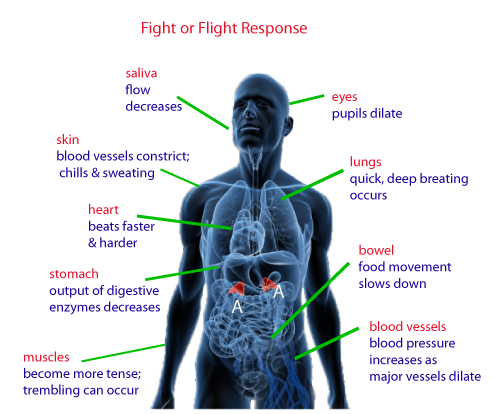
When we experience stress, our body prepares for action. This response is popularly known as the "Fight or Flight response". The CDC describes it well:
“Stress sets off an alarm in the brain, which responds by preparing the body for defensive action. The nervous system is aroused and hormones are released to sharpen the senses, quicken the pulse, deepen respiration, and tense the muscles. This response (sometimes called the fight or flight response) is important because it helps us defend against threatening situations. The response is preprogrammed biologically. Everyone responds in much the same way, regardless of whether the stressful situation is at work or home.” (http://www.cdc.gov/niosh/docs/99-101/)
Muscle Tension Activity
“FREEZE. Don’t move a bit! Now pay attention to your body sensations and position. Can you drop your shoulders? If so, your muscles were unnecessarily raising them. Are your forearm muscles able to relax more? If so, you were unnecessarily tensing them. Is your body seated in a position in which you appear ready to do something active? If so, your muscles are probably unnecessarily contracted. Can your forehead relax more? If so, you were tensing those muscles for no useful purpose. Check your stomach, buttocks, thigh, and calf muscles. Are they, too, contracted more than is needed? Unnecessary muscular contraction is called bracing. Many of us are guilty of bracing and suffer tension headaches, neck aches, and bad backs as a result. Take a moment for yourself now. Concentrate on just letting as many of your muscles relax as possible.” (Greenberg, p.7)
Do you find yourself bracing? For example, it can be easy to brace your shoulders while you work on the computer. Become aware of your posture and focus on relaxing your muscles. One way to do this is by a technique called Progressive Muscle relaxation. click here for more about progressive muscle relaxation
Why is Stress Management important?
Daily hassles can keep your body in a constant, chronic state of “fight or flight” response. This is hard on your body. In a “Stress At Work” NIOSH report , the CDC says:
“Short-lived or infrequent episodes of stress pose little risk. But when stressful situations go unresolved, the body is kept in a constant state of activation, which increases the rate of wear and tear to biological systems. Ultimately, fatigue or damage results, and the ability of the body to repair and defend itself can become seriously compromised. As a result, the risk of injury or disease escalates.”
When you think about it, our body's physiological response to stress is amazing. Our hearts pump faster, our respiration increases, our muscles tense for action. We are biologically programmed to rise and take on challenges and threats. However, many of our 20th century stressors tend to create a chronic stress response, which is why stress management is an important part of good health. The good news is that you have more control over this stress response than you think! This is because the stress response all begins with your perception.
Perception & Stress
Stress does not start until there is a cognitive interpretation of the stressor. A situation can be stressful or not-- it depends on your perception of the event. As the Hardiness Theory states, you will experience less stress in your life if you can perceive potentially stressful situations as a challenge instead of a threat.
The Stress Model
Life Situation -->
Perceived as Stressful -->
Emotional Arousal -->
Physiological Arousal -->
Consequences
Live In the Moment
Participate in the moment and enjoy life as it comes. Although it is important to plan for the future, it is not good to dwell and worry about it. Worrying will not ease your stress of tomorrow, but instead drains your strength of today. Sometimes it helps to just take it one day at a time and live in the present. As dear Edna Mode (from the Incredibles) wisely suggests, “Never look back, darling. It distracts from the now.”
“The past is behind, learn from it.
The future is ahead, prepare for it.
The present is here, live it.”
There are many different techniques and ways to manage stress, but in our workshop we focused on 3 areas: Time Management, Humor, and Meditation.
Time Management Tips
Assess how you spend your time
Set goals (daily, weekly, monthly, yearly)
Prioritize your goals and activities
Create your schedule
Know when to say “No”
Delegate
Evaluate Tasks Once
Limit Interruptions
Invest Time
The quadrant to the right helps us prioritize our daily tasks. Ask yourself: Is this urgent or not urgent? Is this important or not important? By prioritizing your “to-do” list, you can better manage your time and avoid stress.
Humor
The average child laughs 300 to 500 times a day while the average adult laughs only about 15 times a day. We can learn from children’s example to find joy in even the little, daily experiences.
When life gets stressful, sometimes it is just good to laugh! Laughter has beneficial physiological effects on the body-- supporting the old saying that “laughter is good medicine.”
“Humor results in both physiological and psychological changes. Laughter increases muscular activity, respiratory activity, oxygen exchange, heart rate, production of catecholamines, and endorphins. These effects are soon followed by a relaxation state in which respiration, heart rate, blood pressure, and muscle tension rebound to below normal levels. Psychological effects include the relief of anxiety, stress, and tension; an outlet for hostility and anger; an escape from reality; and a means of tolerating crisis, tragedy, and chronic illness or disabilities” (Greenberg, p. 184).
Meditation
“When you get into a meditative, prayer-like, contemplative frame of mind, the metabolism slows down, the immune system is refreshed, blood pressure and heart rates subside, blood lactate level falls, and oxygen consumption and carbon dioxide production are diminished. A lot of changes happen, the result of which is that the body becomes healthier.” --Dr. Keith J. Karren
Take some time today to just relax and meditate.Research has shown that meditation has many wonderful physiological effects, including:
reduced pain perception
decreased respiration
decreased muscle tension
decreased heart rate
better able to cope with stress & more stable autonomic nervous system
positive effects on blood pressure
lowers baseline cortisol
better brain function, ability to control thoughts and focus
improves sleep behavior
(Greenberg, p. 245)
Our last Positive Attitude Development Workshop is Tuesday, February 18th. We will be discussing the health benefits of gratitude, humor, and having a positive attitude. Hope to see you there! Additional Resources:
"No act of kindness, no matter how small, is ever wasted." - Aesop
Breast cancer survivor Lauren E. Miller says: "When you are grateful and practicing random acts of kindness in your life, you end up feeling safe and connected to that which is good and true in this world and the result is inner calm, clarity of thinking and a heart full of love."
According to scientific studies, some of the physiological benefits to this experience include:
Increased immune system
Improved Cognitive Performance
Increase in energy
Lower heart rate
Balanced cortisol levels which result in less internal stress
More likely to live a longer and more satisfied life
Laughter and inner joy resulting in decreased stress hormones; lower blood pressure; diminished pain
Thanks for everyone who
came and made class so much fun! We appreciate your participation and the great
thoughts you bring to class. Here are some notes and resources from Tuesday.
Goal Setting
In order to have direction in
life, we need vision of where we want to go and set goals to get there. Goal
setting is the difference between wishing for something to happen and making it
happen. There are several benefits of setting goals:
Keeps us on track
Forces us to establish a
direction
Improves our self-esteem as we
achieve small accomplishments along the way
Makes us aware of our
weaknesses
Makes us aware of our
strengths
Brings to mind past victories,
which energizes our present state of mind
Defines reality and separates
it from wishful thinking
Sets a standard for our
decision-making process
When setting goals, make
sure they are SMART: Specific, Measurable, Attainable, Realistic,
Time-oriented. Following the SMART criteria gives focus to our goals and
empowers us to succeed.
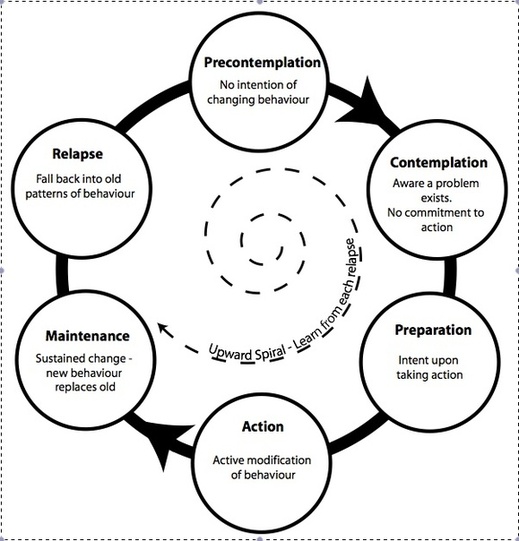
Stages of Change
Change is a process, and setbacks are part of the process. Remember, “you have not failed until you quit trying!” Don’t give up!
Tenacity While Achieving
our Goals
Change takes time. Achieving goals will be a process. Because set-backs are expected, persistence is an essential ingredient to success. Lyle Wildes says,“(let) go of
setbacks and (accept) them as temporary, rather than dwelling on them as if
they are permanent. In fact, something that appears to be failure is often a
step along the road to success.”
“If at First You Don’t Succeed, You’re in Excellent Company”. This article gives
several inspiring examples of overcoming setbacks and disappointments. When you find yourself struggling, remember
that success if often just around the corner.
Tenacity through Life’s
Detours
“It
is more useful to think of a meaningful life as a journey that unfolds before
us. It is smart to have a map to guide our trip, but it is also smart to be
prepared for detours, surprises and beautiful vistas that do not appear on the
map. Setting a goal is like creating our own personal map.” --Lyle Wildes
While it is important to
set goals, we also must be flexible for life’s surprises. Each of us will
experience life’s “peaks and valleys” -- times of success, and times of adversity. In the workshop we discussed one Mother's inspiring
story of raising handicap children. Though all of our life challenges will be different, we can learn
from her inspiring example. She overcame her valleys with tenacity and
optimism. We too can reach our life goals despite our personal life trials.Welcometo Holland Story
Martin Seligman’s Learned optimism
The benefits of an optimistic outlook are many: Optimists are
higher achievers and have better overall health. Pessimism, on the other hand,
is much more common; pessimists are more likely to give up in the face of
adversity or to suffer from depression. Seligman invites
pessimists to learn to be optimists by thinking about their reactions to
adversity in a new way.
Three P’s to thinking more
positively during adversity
Permanence: Optimistic people believe bad events to be more
temporary than permanent and bounce back quickly from failure, whereas others
may take longer periods to recover or may never recover. They also believe good
things happen for reasons that are permanent, rather than seeing the transient
nature of positive events. Optimists point to specific temporary causes for
negative events; pessimists point to permanent causes.
Pervasiveness: Optimistic people compartmentalize
helplessness, whereas pessimistic people assume that failure in one area of
life means failure in life as a whole. Optimistic people also allow good events
to brighten every area of their lives rather than just the particular area in
which the event occurred.
Personalization: Optimists blame bad events on causes outside of
themselves, whereas pessimists blame themselves for events that occur.
Optimists are therefore generally more confident. Optimists also quickly
internalize positive events while pessimists externalize them. (taken from: http://en.wikipedia.org/wiki/Learned_optimism)
Goal Setting &
Self-Esteem
What is self esteem? Self-esteem is having confidence in one's own worth
or abilities; self-respect; positive regard for yourself; feelings of
worthiness. Self-esteem is different than self-worth. Your personal worth is
great and it never changes. What you think about your worth,
however, does fluctuate. We must be careful not to tie our self-esteem to
external factors, such as job position, relationship status, income level, and
so on. These external factors are unstable, and thus builds your feelings of
self-respect on a shaky foundation. Positive self-esteem is independent of
those external factors. It is when you come to realize your great worth and
love yourself.
Self-esteem
is closely tied with self-efficacy, which is our confidence in our ability to
carry out actions. As we strive towards our goals, we will increase our
feelings of self-efficacy and consequently improve our feelings of self-esteem.
Lyle Wildes says that
self-esteem ties in with humility, service, and respect.
Self-esteem &
Humility
“Strong self-esteem and meaningful living have their roots in
humility...True humility is not the same as humiliation. While small, our place
in the universe still has meaning. In other words, healthy self-esteem requires
the humility of balance-- living without either grandiosity or self-abasement.”
--Lyle Wildes
“Humility is not thinking less of yourself. It
is thinking of yourself less.” --C.S. Lewis
Self-esteem &
Service
“Self-esteem grows through true, selfless
service to people--including to ourselves. Such service is totally in our
control, which means that our self-esteem is also in our control.”
-- Lyle Wildes
One study found that “those who gave social
support to others had lower rates of mortality than those who did not, even
when controlling for socioeconomic status, education, marital status, age,
gender, and ethnicity” (Brown et al., 2005).
Self-esteem &
Respect (for ourselves and
others)
Wildes also talks about how self-esteem is
related to respect, and how we need to respect other and ourselves. As we are
striving to improve all dimensions of our health, that is self-respect!
Consequently you will feel better about yourself.
A cute reminder that
“you can do anything good!” There is something powerful about saying positive
affirmations aloud. Though you may feel silly, say some daily affirmations
aloud to yourself today.
You have great potential
to do something amazing today! “So get to it!”
If you would like a
WORKBOOK, please email us at ucwell4life@gmail.com and we will send you a copy. We will also have extras
at our next workshop on February 11th. Hope to see you there!
Jan 28, 2014
Positive Thinking Workshop Week 1: The Power of Your Thoughts
"It is so important for us to develop new attitudes, thoughts, and beliefs--so that we have more capacity to successfully deal with the new and surprising situations life has in store for us." - Lyle Wildes
What is your definition of health? We believe that society puts a greater emphasis on the physical aspect of health. We recognize that working on physical health is noble, but we see a need to focus more attention on our emotional health. After all, having a positive attitude has many physical health benefits such as; stronger immune system, heart health, longevity, better cholesterol and lower your risk for a stroke.
The purpose of this workshop is to:
Increase awareness of your thoughts
to understand the powerful mind/body connection of thoughts
and equip you with some tools to improve your thoughts
Dr. Amen, an award winning psychiatrist, blames negative thinking on 9 ANTS or "Automatic Negative Thoughts." He claims that if we can squish the ANTs in our lives we will start thinking more positively. The species of ANTs that many people encounter in their lives include;
Always/Never thinking: Thinking that something that happened will 'always' repeat itself.
Focusing on the negative: Only see the bad in a situation and ignore any of the good parts that might happen.
Fortune Telling: Predicting the worst possible outcome to a situation
Mind Reading: Believing that you know what another person is thinking even when they haven't told you.
Thinking with your feelings: Believing your negative feelings without ever questioning them.
Guilt Beatings: Happen when you think words like 'should, must, ought, or have to.'
Labeling: Whenever you attach a negative label to yourself or someone else, you stop your ability to take a clear look at the situation.
Personalization: Occurs when innocuous events are taken to have personal meaning.
Blame (The most poisonous red ANT): When you blame something or someone else for the problems in your life, you become a victim of circumstances and you cannot do anything to change your situation.
Taken from http://ahha.org/articles.asp?ld=100
If we can challenge every thought that we have for its validity and talk back to the negative thoughts, we will be able to 'squish' the ANTs that are present in our lives.
We would like to extend the Happiness Advantage Challenge to everyone. Choose one of the following activities to participate in everyday for 21 days. If you do this devotedly you will see a difference in the way you perceive the world.
Write down 3 different gratitudes
Journal one positive experience
Exercise
Meditation
Random Acts of Kindness
Come next week at the same location and time (Health and Justice Building 2601 @11 AM) for more insights on developing a more positive outlook on life.
This year we want to encourage more physical activity throughout the workday so we're encouraging employees to take 2 10 minute walks, one in the morning and one in the afternoon to break up the day a little bit and squeeze some daily physical activity into your stressful work-packed days. We're calling it 'Take 10' and will have monthly drawings for everyone who takes 2 ten minute walks at least 4 out of 5 days each week and returns their punch cards at the end of each month.
Start walking today!
Maybe you
haven’t started your Christmas shopping… or are having trouble finding
something for that last person on your list?
Have the holiday treats staring piling up on your front door? Are the holiday parties and activities
filling up every night of your week? Did
you go over-budget?...
Here are a couple of our favorite holiday stress relievers…
“Quiet
time with the Christmas Tree”Appreciate the little things we love
about the holidays… like spending the evening cuddled up on the couch watching
cheesy Hallmark movies by the light of the Christmas tree. There are so many little things about this
time of year to appreciate. What is your
favorite thing about the season?
“White
Space”Is your calendar crammed with night after night… after night
holiday activities? Don’t cram so much
into the holidays that you can’t enjoy them.
Be sure and schedule free-time, some down time to do nothing but enjoy
the lit up Christmas tree. Don’t be
afraid to say ‘no’ to that extra holiday party.
“Make
your list and check it twice!” Prioritize your holiday activities. What is most important to you? Use your priority list to make a plan. Organize your ‘to do’list so you have some direction as you navigate the busy holiday season.
“Buddy the Elf”What do we all love about Buddy the
Elf?
He is such a positive person, just rolls
with the punches and MAKES US LAUGH! Let’s not forget to laugh at the funny things
this holiday season and even the not so funny things…if nothing seems to be
going right (we all have those days!) just laugh about it. There’s no reason to stress over things we
can’t control.
“Watch
Your Wallet”Watch your wallet so you don’t get pick-pocketed….and make
your holiday budget and stick to it.
There are lots of great ways to save money like shopping holiday sales, making homemade bread, rolls or
jam for your neighbors, making homemade
heartfelt gifts, take your family to the dollar store to purchase family gifts…this
could be very entertaining!